
Genetic Causation

Hannah Allen, Bennet Knox and I have just had a paper published: https://link.springer.com/article/10.1007/s10519-026-10264-2
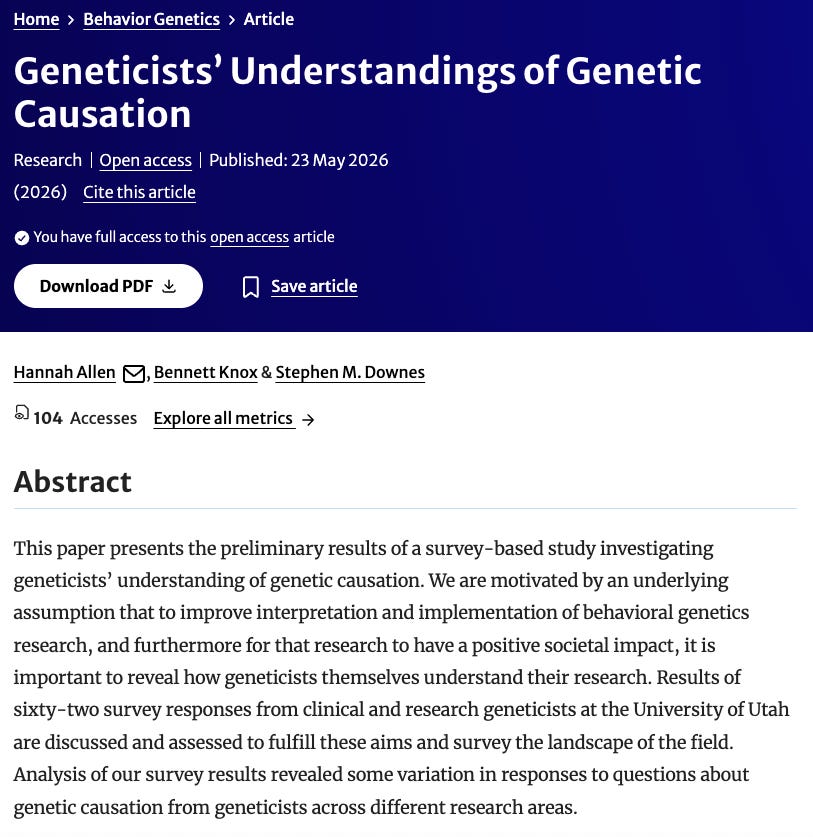
We started work on the project that resulted in this paper around 3 years ago, when we were all at the University of Utah. I retired last July and Hannah and Bennett both graduated with Ph.D.s in 2025 and now have academic jobs. Hannah and Bennett both received grant support from the Utah Center for Excellence in ELSI Research (UCEER) project at the University of Utah, funds for which were from NIH through the Ethical, Legal and Social Implications (ELSI) Research Project at the National Human Genome Research Institute. We enjoyed the help and support of the folks at UCEER and help and support from the wider genetics community at the University of Utah. Over one hundred geneticists and associated researchers responded to our survey about geneticists attitudes towards genetic causation. We were able to use 62 completed surveys. Several geneticists at the University of Utah also gave us their time to discuss their responses to our survey and issues about genetic causation in general.
What is genetic causation and why are we interested in the topic? People make claims of genetic causation when they say that a gene, or some genes, is/are responsible for traits. “Trait” (or “phenotypic trait”) is the biological term for features like hair color, eye color, height and weight but also for diseases that individuals have, such as sickle cell disease or cystic fibrosis. Some diseases result from one gene or one specific DNA sequence that differs from the sequence in the same location in the genomes of people without the disease. In these cases, we can say that the gene, or DNA sequence, is causally responsible for the trait. The alternate sequence of DNA could code for a different protein than the sequence that most folks have and that protein could be responsible for disease symptoms.
We are interested in genetic causation because a wide range of human traits are attributed to genes. Think about differences in human adult height. Many people, both scientists and lay folks, claim that height is genetic. However, this sense of genetic cannot be easily mapped onto the one briefly outlined above. There is no single DNA sequence that, if changed, results in taller or shorter people. Height is heritable, which means that children are closer to their parents’ height than they are to the height of other random folks in the population. Traits that are heritable are often referred to as genetic traits but a little care is needed here. Wealth is passed on from one generation to the next, as is religion, what football team we support and so on. Do we support the same football team as our parents as a result of genetics? Does supporting Liverpool FC have a genetic cause? To some geneticists the answer to this question is perhaps, so let’s find out. The way we go about finding out about the potential genetic underpinnings of social or behavioral traits is different than the way we go about finding out about the genetic underpinnings of the diseases just discussed.
Family studies long predate the discovery of genes and DNA. Animal breeders studied the inheritance of traits long before genetics was introduced into agricultural practice. If diseases were found to run in families over generations, they were understood to be heritable diseases. Before we had any knowledge of genetics, paternity was questioned on the basis of traits like hair color, height and even demeanor. How could that child be descended from that man? (The TV show Poldark spends a great deal of time on such themes and was set well before any scientific work in genetics.) Studying families across generations provided the foundation for medical genetics and also the genetics that focuses on social or behavioral traits. Several breakthrough discoveries were made in medical genetics allowing scientists to discover genes responsible for diseases by initially inferring from the pattern of inheritance of the relevant disease.
Are there any similar breakthroughs in the genetics of social and behavioral traits? Well, that depends on which geneticists you ask. There are hundreds, if not thousands, of papers on the genetics of IQ, educational attainment, religion, personality types, age at first use of cannabis and so on and so forth. These papers are the outgrowth of a specific approach to family studies: twin studies. Identical, monozygotic, twins have the same genetic makeup. Twin studies researchers developed formal techniques for modeling the contribution of genes as opposed to environment to a wide range of traits. Where animal breeders performed experiments to test their genetic hypotheses about traits, human twin studies researchers analyzed phenotypic trait data mathematically. Human twin studies produced, and continue to produce, claims that traits are more or less genetic. That is, genes contribute more to the trait than the environment does. So, people working in this area of genetics are not answering the question: does having a specific gene (or DNA sequence) determine this trait? Rather, they are answering the question: is the trait due more to genetics or environment? (Eric Turkheimer’s Understanding the Nature-Nurture Debate carefully lays out the rise of contemporary social and behavioral genetics from twin studies and family genetics.)
Hannah, Bennett and I are convinced that there are many different approaches to genetic causation and that these different approaches are closely associated with the alternate ways in which genetics is studied. Our thinking here is aligned closely with philosophers of science such as Nancy Cartwright, Helen Longino and Anya Plutynski. The philosophical issues here are dense and I won’t delve into them here. Having done so in our paper and elsewhere does reveal some practical suggestions about genetic causation: when confronting a genetic causation claim, tread cautiously. You may have been told that your 23andMe results show that you will have a certain disease, personality type or will die at a certain age. These are all claims of genetic causation but they are not definitive. Without a great deal more research into the particulars of your life, family history and medical history, all you know is that you have some DNA sequences that have been associated with one or other trait. Take this as the starting point of your own inquiry into specific genetic causation claims.